

Many companies are currently facing a key challenge: productivity must increase, whilst economic pressure is mounting and it is becoming increasingly difficult to recruit qualified staff. Processes are becoming more complex, volumes are rising, and additional resources are often not an option.
This is precisely where meaningful AI initiatives come into play. Not as an end in itself, but as a targeted way of reducing the burden in areas where time and money are wasted in everyday life. The key question here is not whether AI should be used, but where it delivers measurable added value.
In this article, we use an anonymous practical example to show how a very specific finance-use case emerged from this structured use-case analysis:
AI-supported account assignment suggestions in the workflow for transfer to Microsoft Dynamics 365 Business Central.
It was no coincidence that this focus became apparent so quickly. Our AI Use Case Discovery Workshop served as the methodological basis. It helps to identify and prioritise use cases and, in collaboration with business departments and IT, to make them assessable, including requirements relating to data, integration, security and operations.
The starting position
From a broad perspective to an actual use case
In many companies, AI begins with a broad collection of use cases. This was also the case with our client, a medium-sized company in the wastewater and waste management sector. Following our first meeting, the decisive moment came when one department identified a very specific pain point.
The financial accounting department asked a clear question:
“We would like to improve the account allocation for our journal entries in the workflow.
Is there a way to automatically generate default values in JobRouter?
So that journal entries can be transferred to Business Central in a properly prepared format.”
But how did this come about? The aim of our meeting was to understand meaningful areas of application for AI and to work out together where it can have a rapid impact. During the discussion, typical use cases from business units and IT were brought up – the sort that frequently arise in service-oriented companies:
- Automatic vehicle detection
- Maintenance and TÜV early warning system
- Fleet Load Analysis
- Automatic damage analysis
- Automatic offer creation
These are good starting points. At the same time, many workshops show a pattern. The most exciting ideas are not automatically the ones with the biggest lever. The biggest lever is usually where routine work is required every day, which adds up to very high effort over the year.
This is exactly why the question from financial accounting was so relevant. The account assignment works per document like odds and ends, but scales massively at high volumes and thus becomes a Relevant Cost Drivers, although a large part of the decisions can be efficiently supported on a historical basis.
This is a typical discovery result. A use case is not invented. It is made visible. Where daily effort is made.
Would you like to find out which use case has the greatest leverage in your company?
Then our AI Use Case Discovery Workshop is your fastest entry.
The challenge
Account allocation is time-consuming and resource-intensive
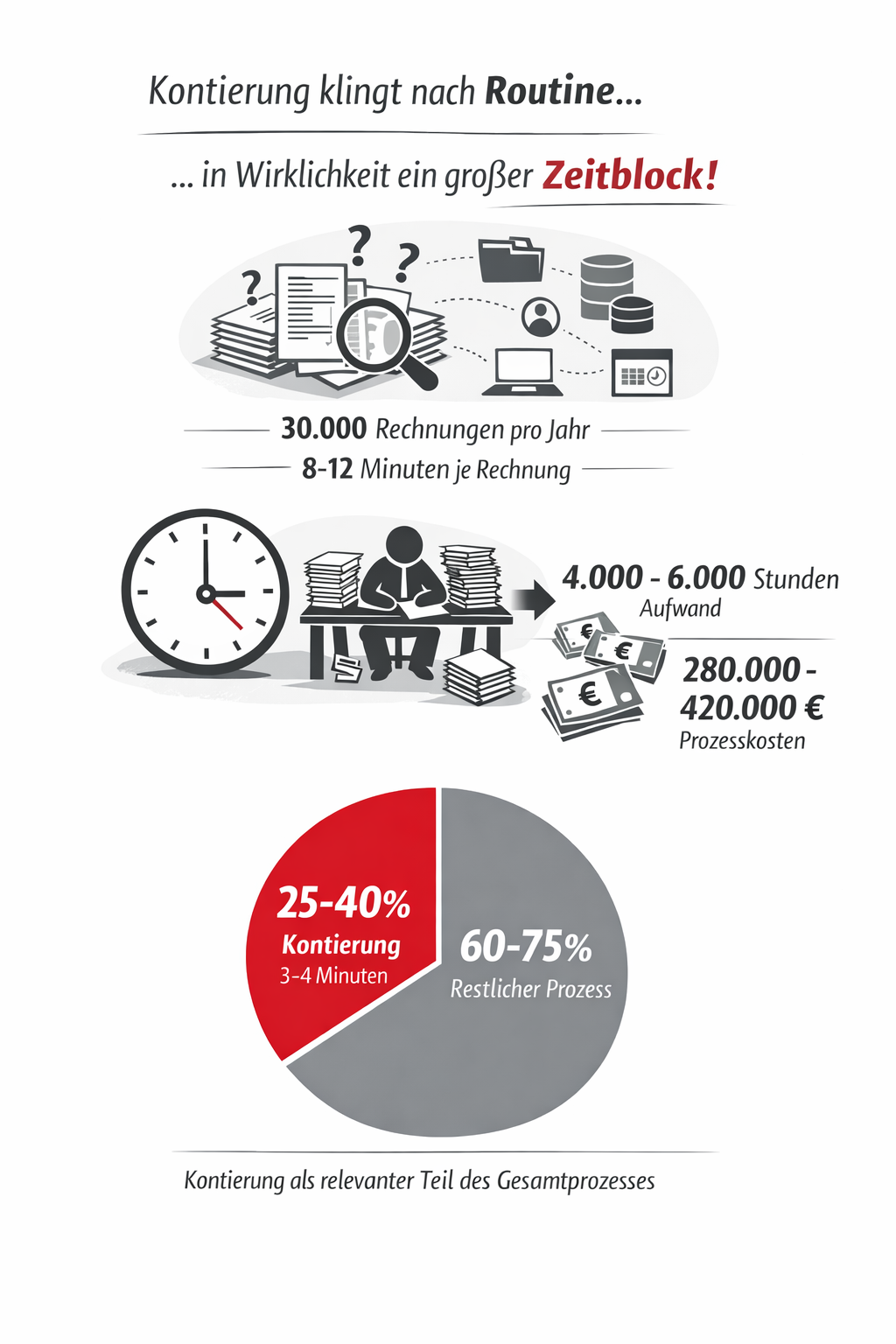
Account allocation sounds like a routine task. In reality, it takes up a lot of time because several decisions have to be made for each invoice and because information is often scattered across different sources.
In our anonymized example, the key data were included ~30,000 bills per year. Depending on the process acceptance, the effort per invoice with 8 to 12 minutes considered. That gives a total effort of 4,000 to 6,000 hours per year and process costs in the order of 280,000 to 420,000 euros. (Sample calculation, rounded; depending on hourly rates/process)
A classification that applies to many companies is important. account assignment is often not the complete process, but a relevant part of it. A typical orientation is often 25 to 40 percent of the overall process, often 3 to 4 minutes per invoice.
Where exactly does the effort come about?
Account assignment effort is typically incurred here.
Select G/L account → Determine cost center or cost unit →
Check control key → Comparison with similar invoices from the past →
Questions for unclear invoices
The lever is that many decisions follow recurring patterns:
- sample by supplier.
- pattern by performance.
- sample by cost center.
- pattern by history.
Would you like to find out which use case has the greatest leverage in your company?
Write to us using the contact form and book our AI Use Case Discovery Workshop
Why workflow systems alone cannot solve this
Workflow systems such as job routers control processes very reliably. Documents are recorded, checked, released and then transferred to the ERP. What is often missing is not the process, but the technical understanding of the content.
Because a workflow system does not automatically recognize which historical postings fit an invoice and which account assignment is common in the company. It cannot interpret invoice texts semantically, derive patterns from the posting history or create justified suggestions.
What it means for JobRouter
JobRouter excels at orchestrating processes. However, without customisation, JobRouter does not typically provide intelligent account allocation suggestions, as this would require the following capabilities:
- Semantic understanding of invoice texts
- Deriving suggestions from historical booking practice
- Recognize and rate similar bookings
- Understandable reason why a specific account or dimension is proposed
Exactly this gap closes modern AI when it is cleanly connected to your Business Central history. This results in default values that can be integrated into the existing workflow without job routers having to become an “accounting brain” themselves.
The solution approach
AI supported account assignment with history from Business Central
The basic idea is simple: Account assignment suggestions do not arise from “magic” but from corporate knowledge. And this knowledge is already available: in the historically booked processes in Business Central.
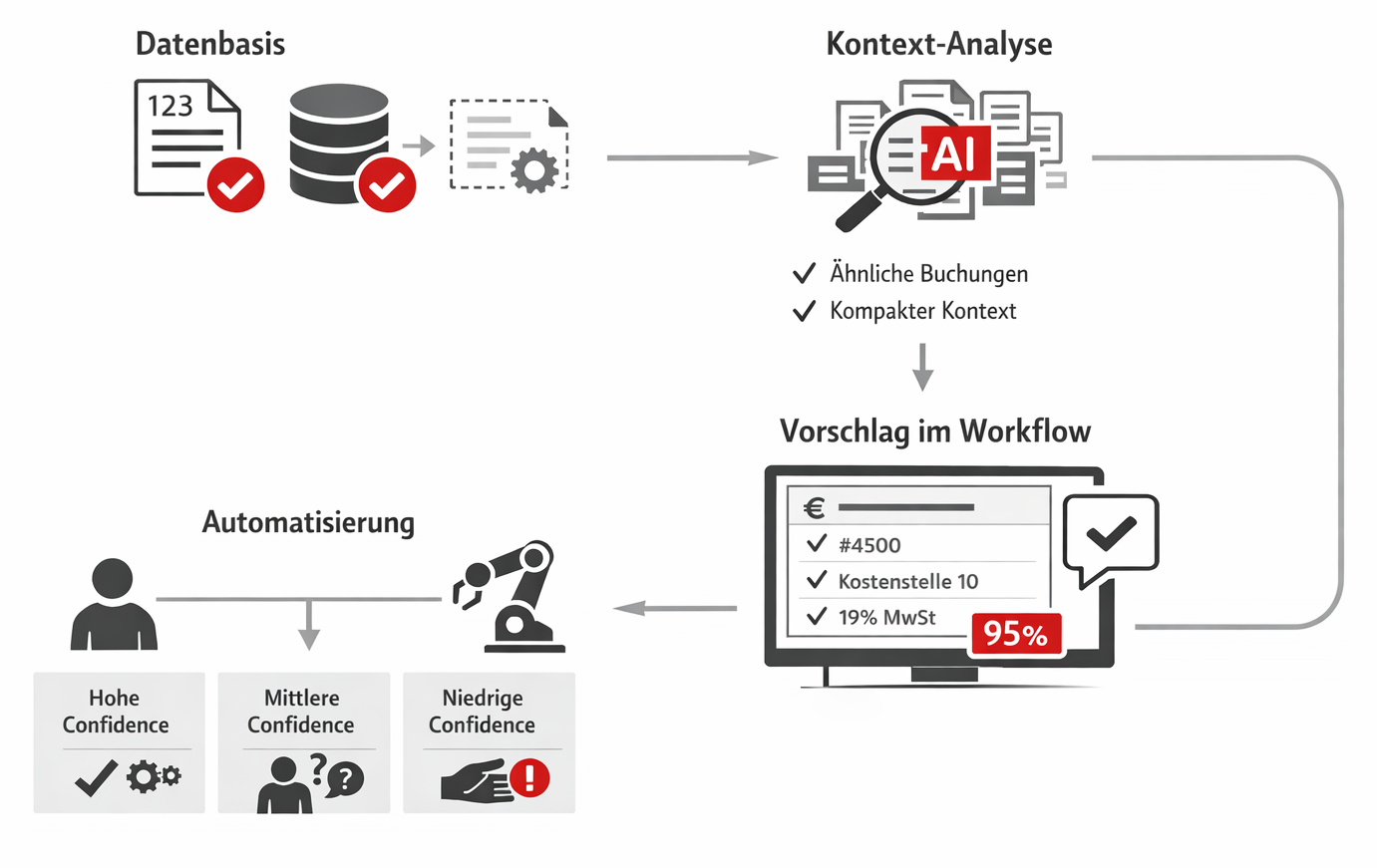
1. Database: What AI really needs
The following data is particularly relevant for practical account allocation suggestions:
- Invoice information from the workflow (Creditor, text, amounts, items if applicable)
- Historical postings from Business Central (funds, dimensions, tax keys, posting groups)
- Chart of charts + dimensions logic
- Optional: Documented rules / exceptions (if present)
2. ‘Context first’: AI is given the right examples – not the whole mountain of data
Instead of dumping huge amounts of data into a model, you work more efficiently like this:
- We determine the most similar historical bookings based on creditor, text and features
- This creates a compact context (e.g. the top examples with high relevance)
- The AI generates structured suggestions from this – including justification and confidence
3. Output in the workflow: Proposal + Confidence + Justification
No “Blackbox text” is required in the job router, but a clean suggestion data record, e.g. B:
- G/L account
- Cost center / dimension(s)
- control key
- Confidence Score
- Brief justification ("Similar to X Historical Bookings for Vendor Y")
4. Human-in-the-loop: Automate where it is safe
In practice, a simple mechanism works:
- High Confidence → Proposal can be pre-assigned automatically
- Medium Confidence → Proposal is displayed, employees confirm
- Low Confidence → No Automation, Assistance Only
This creates acceptance – and the quality increases quickly because feedback from practice is flowing back.
If you think of similar solutions but are not sure where to start, write to us using the contact form and book our AI Use Case Discovery Workshop
We’ll get back to you within a short time with suggestions for appointments.
Why this approach works and pays off
The crucial thing about this use case is clarity. Instead of discussing AI as a tool question, the actual bottleneck was made visible and prioritized in the AI-use-case discovery workshop: manual account assignment effort, time ties and costs. That’s why the approach is so effective.

The use of the existing Business Central history results in suggestions that match the company’s real booking practice. This reduces search effort and queries, speeds up the invoice run and increases consistency. Employees no longer start from every invoice, but only check and confirm where it is necessary. So Improves efficiency in day-to-day business and at the same time cost controlbecause there are fewer manual minutes per invoice.
The cost factor also remains to be planned. You start focused with a clearly defined use case and a safe approach instead of investing in broad-based AI experiments.
What that means economically
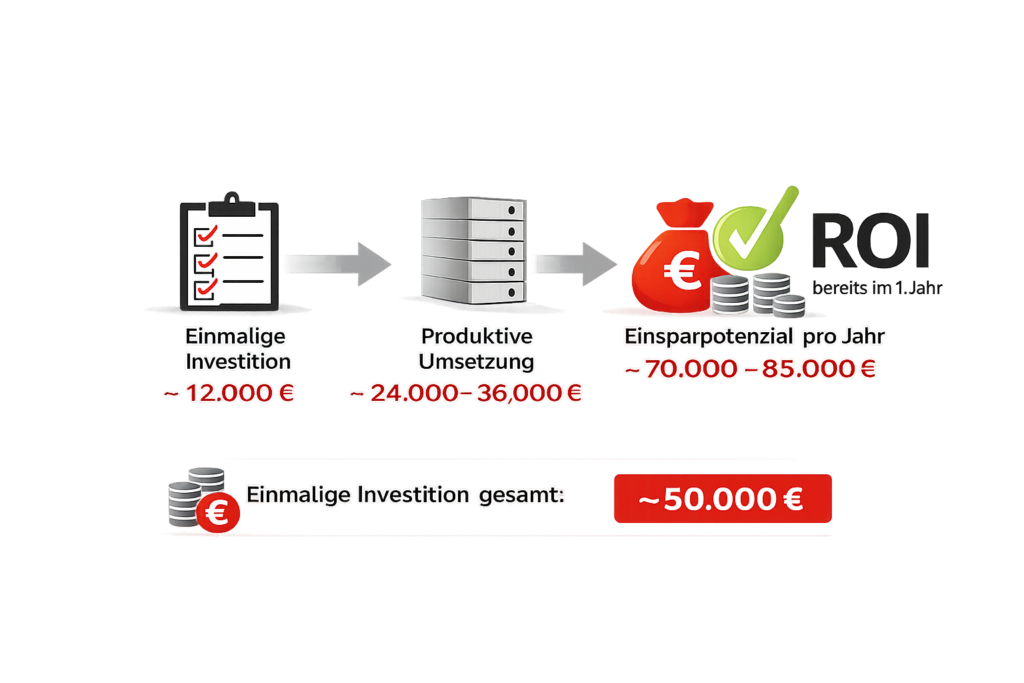
The target image was that AI-supported account assignment could reduce manual effort by ~50-60%. Depending on the wage cost and process, a savings potential of around €70,000 – €85,000 can be derived from this. In addition, there are other effects such as fewer queries, faster throughput times and scalability without additional staff.
What does it cost and when does it pay off?
In order for this savings potential to become a real effect, a one-off implementation is required in clear steps. In our example, a Proof of Concept with around 12,000 euros scheduled. For the productive implementation, the framework was 24,000 to 36,000 euros, depending on integration and process details. Overall, this results in one One-time investment of around 50,000 euros.
If you ask the derived Savings potential of 70,000 to 85,000 euros per year opposite, the business case becomes tangible. The return on investment can thus be achieved in the first year. In addition, the ongoing AI operating costs usually remain low in relation to the process benefit, because manual minutes per invoice are mainly reduced.
Why many AI initiatives don't take action
In practice, we see three reasons why AI initiatives often falter.
- There are too many ideas and too little prioritization.
- The benefit remains too general, so budgets are not decided.
- IT questions come too late, then things get complicated in the project.
The discovery step is the alternative. It creates clarity to use and feasibility and provides a prioritized shortlist that serves as a basis for decision-making.
Why this example is a perfect AI-use-case discovery
This example shows what we observe in many companies.
The first AI impulse often lies with visible topics.
The biggest lever is then often where daily routine expenses arise that will last throughout the year add up to significant costs.
That’s exactly what he’s for AI Use Case Discovery Workshop there. not to collect as many ideas as possible, but to finding use cases that really work.
And to take the IT with you from the start, so that a use case does not become a risk, but a predictable project.
If you want to use AI effectively in the company, don’t start with the tool. Start with the use Case.
Together with you, we identify the use cases with the greatest leverage, classify them technically and economically and create a prioritized basis for the next steps.
This way, many ideas become a focused use case that increases efficiency and reduces costs.

contact
Find your use cases with real ROI.
Contact us via the contact form for a non-binding initial consultation. We’ll get back to you as soon as possible with suggested dates.