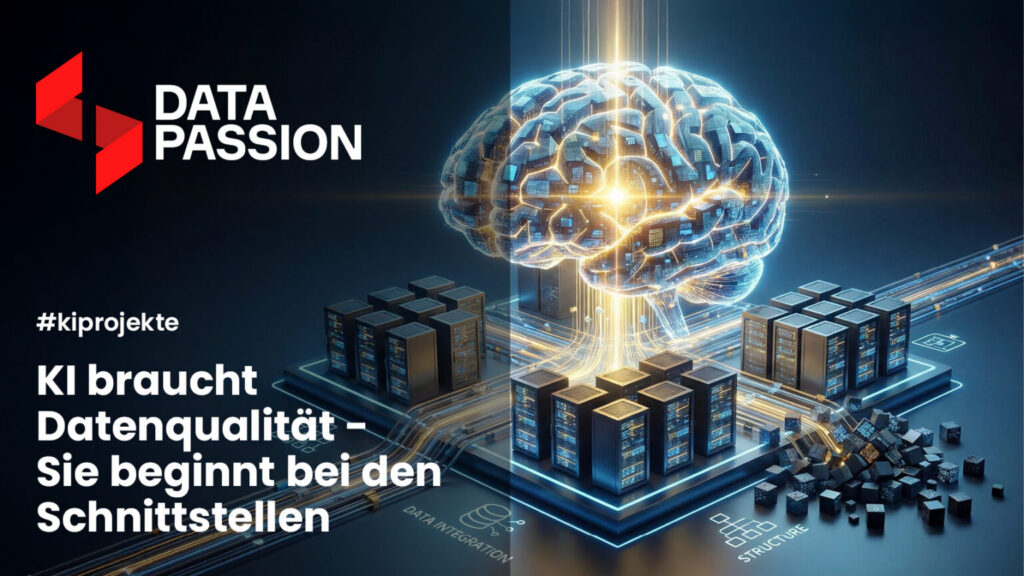

AI works best where the database is right for the specific use case. That sounds natural. But in practice, in integration projects, we experience again and again that exactly this basis is missing when companies start their first AI project.
Not because the technology wasn’t ready. But because data is maintained differently in several systems, interfaces are undocumented or nobody knows exactly which data status is up-to-date and correct. This can often be compensated for for day-to-day operations. But as soon as an AI model is to work on this basis, these weaknesses become visible.
Gartner predicts that by 2026 companies will give up around 60 percent of their AI projects that are not supported by sufficiently processed data. We also see integration projects: data quality is often the bottleneck, not the AI itself.
From our daily work with interfaces and system landscapes, this article shows what is important when AI projects are to be based on existing structures.
Are you considering whether AI makes sense in your company? In the AI Discovery Call, we check together whether there is an economically relevant AI project and whether a next step is worthwhile. Free and without obligation.
Why AI aggravates data problems that were hardly noticed before
Integration has been everyday life in many companies for years. ERP, CRM, accounting, specialist systems: Data flows from A to B via interfaces. In many cases, this works well enough for day-to-day operations.
But “Good enough” can become a problem with AI.
AI models work with the data you get. If an ERP system has different customer statuses than CRM, if master data is outdated or in multiple systems, an automation based on it produces systematically questionable results. Not as an individual error, but with every execution.
The special thing about AI: The errors are often not immediately visible. A model that creates recommendations or forecasts on inconsistent data delivers results that look plausible, but are on a false basis. In the classic integration company, a missing data set will be noticed at some point. With AI, a systematic error can go unnoticed for a long time.
What we know about data quality from integration projects
Our focus is on the technical starting point. And there we encounter the same patterns over and over again in projects.
The same data is maintained in several systems, without clear synchronization rules. Customer data in the ERP, parallel in CRM, sometimes also in specialist systems. Every team works with “his” system, and as long as no one has to combine the data across systems, the inconsistency is hardly noticeable. Different address statuses, double data records, contradictory assignments: In integration projects, the adjustment of these contaminated sites is regularly more complex than the actual system connection.
Interfaces have grown historically and not documented. Over the years, connections between systems are established, adapted and expanded. Which data flows in which format via which interface is often only stored in the mind of individual people. As soon as a new requirement is added, the overview of what is actually available and resilient at all is missing.
Errors in data flows are only noticed when something is missing in the target system. Without active monitoring and logging, problems often only arise when a follow-up process is already disturbed. Troubleshooting starts reactively rather than preventively. This is exactly where more professional sets Integration Support & Operation on.
None of these patterns generally prevent an AI project. But the more a use case is dependent on data from several systems, the more important it becomes to know these points for the specific application and to address them in a targeted manner.
In the AI Discovery Call Let’s check together whether AI is sensible and realistic in your company. Free, 60 minutes, without selling pressure.
Not everything on the following basis: ensure data quality where AI should work
A frequent Misunderstanding: Before AI is possible, the entire system landscape must be perfectly integrated. That’s not true.
The decisive factor is that the data is resilient for the specific use case. If an AI model is to create account assignment suggestions based on historical posting data from an ERP system, then exactly this posting data must be consistent and available. Whether another system is not yet cleanly connected at the same time does not matter for this use case.
In concrete terms, this means: For the use case that you want to implement, you should be able to answer these questions:
For the use case you want to implement, you should be able to answer these questions:
- Data origin: What data does the use case need and what systems do you come from?
- consistency & Up-to-date: Is this data consistent and up-to-date, or are there conflicting statuses?
- Interface documentation: Are the relevant interfaces documented and reliable?
- monitoring & Error handling: Is there a monitoring that detects errors in these data flows?
- Responsibilities: Is it clear who is responsible for the quality of this data?
Anyone who can answer these questions for their specific use case has a good starting position. If you are unsure, you should start right there.
A concrete example of how this looks in practice is shown by our AI account assignment reference: There, a finance-use case was identified in a structured use case analysis based on historical posting data from Business Central. The success did not depend on the AI model, but to the availability and consistency of exactly this ERP data.
Where DATA Passion comes into play
If the database for an AI use case is not resilient, this is often due to the underlying integration architecture. Systems that are not cleanly connected, data flows without monitoring, interfaces without documentation. This is exactly our area.
Data Passion plans and implements integration architectures, which remain controllable even with increasing number of systems and increasing complexity. We ensure that master and movement data flows reliably between systems and, if necessary, take over the ongoing operation and support of the integration platform.
Whether a company wants to introduce AI, connect a new application or stabilize existing processes: the prerequisite is the same. The systems must work together reliably. Vendor-neutral, based on the technologies that fit the existing landscape.
FAQ: Frequently Asked Questions about Data Quality and AI
AI models make decisions based on the data available to them. If this data is inconsistent, outdated or incomplete, systematic errors arise. In contrast to classic processes, these errors are often not immediately visible in AI because the results can seem plausible, although the basis is not right.
no. The decisive factor is that the data is resilient for the specific use case. Which systems and data flows are relevant depends on the use case. A focused start with a clearly defined use case is much more successful in practice than trying to solve everything at once.
A good first step is to honestly evaluate the data situation for a specific use case: Are the relevant data available, consistent and reliable?
In the AI Discovery Call Let’s check together whether there is an economically relevant AI project and whether a next step is worthwhile.

Get started
Free initial consultation
In a non-binding initial discussion, we will look at your current challenges and potential solutions together.
Honest, direct, free of charge and without obligation.
Write us a short e-mail, call us or fill out the contact form! We will be happy to take care of your request and will get back to you within the next 24 hours.