Microsoft Azure, SAP Integration Suite, Lobster or a combination, we choose the solution that suits your needs, your budget and your IT landscape.
Application Integration
We connect every system with every system
Whether SAP, Azure, Salesforce, Dynamics or a proprietary system, we analyse your IT landscape and build the integrations that your company really needs. Above all, we are one thing: vendor-neutral.
Your systems aren't talking. Your business is paying for it.
Today, companies often use between 20 and 40 different systems, ranging from ERP and CRM to production, logistics and e-commerce. Without smart integration, this leads to manual processes, duplicate data entry and high costs resulting from errors.
Efficient business processes require a scalable integration solution. We connect your systems so that processes run faster, errors are reduced and complexity remains manageable even as your business grows.
- Established Integrations
We implement SAP Integration Suite, Azure Integration Services, Lobster, nServiceBus, Dynamics 365 and Salesforce, tailored to each company’s architecture.
- Customised systems
We connect your own systems, including AWS, Google Cloud, Tradebyte, Datev and other third-party solutions, even where no standard connectors exist.
Our mission is to connect IT landscapes without complicating them, so that businesses can grow without being held back by complexity. We permanently eliminate manual processes and duplicate data entry through integrations that run reliably and evolve alongside the business. Above all, we are one thing: open to all technologies.
Does this sound familiar to you?
- Duplicate data maintenance: Data is manually transferred to several systems. This is error-prone and time-consuming.
- Expertise concentrated in the hands of just a few people: Only a few employees know how the integrations work. A failure becomes a problem.
- New systems are difficult to integrate: Cloud, AI or new tools fail due to outdated middleware, insufficient documentation or lack of architecture.
- Processes that falter: Someone has to step in at every handoff between systems. Orders, delivery status and invoices are all passed on manually.
- No real-time view: Decisions are based on yesterday's data because one system cannot access the other.
- Legacy integration environment: Interfaces have been added over the years, poorly documented and are now difficult to maintain. Changes are risky.
We seamlessly connect your data, processes and systems
Central Control
Processes run centrally together instead of in individual isolated solutions. This saves time, reduces chaos and creates more control.
data availability
Data from ERP, CRM, Support or HR is consolidated in real time. This gives you a better basis for strategic decisions.
Automation
Data and workflows are automatically synchronised between systems. This reduces manual maintenance work and error rates.
scalability
New locations, tools or business areas can be flexibly integrated without complex individual projects.
cost efficiency
More efficient processes and lower maintenance costs reduce IT costs in the long term and take pressure off internal teams.
future proof
Stable basis for digitisation, automation and AI applications without having to completely replace existing processes.
Enterprise Service Bus (ESB)
The backbone of your integration architecture
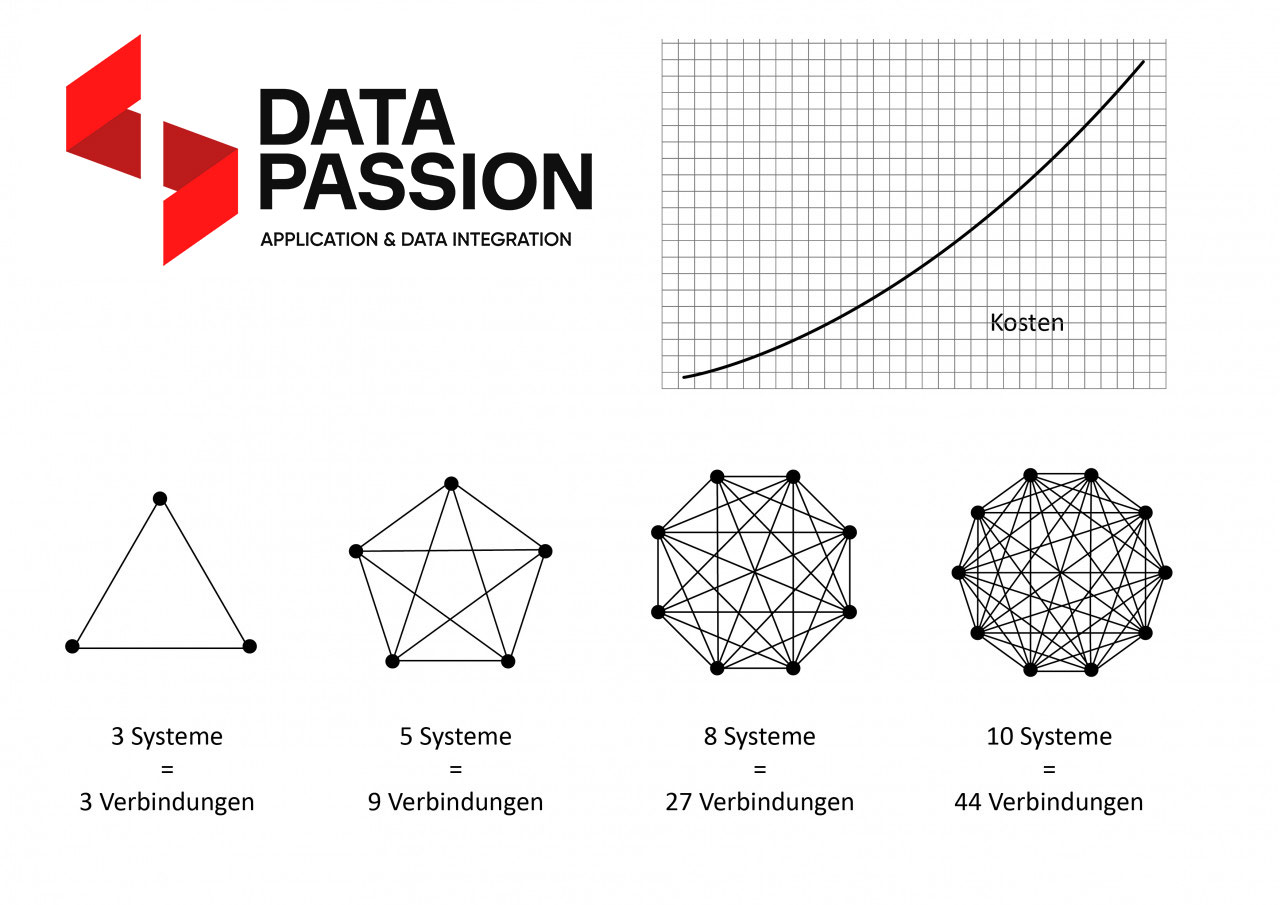
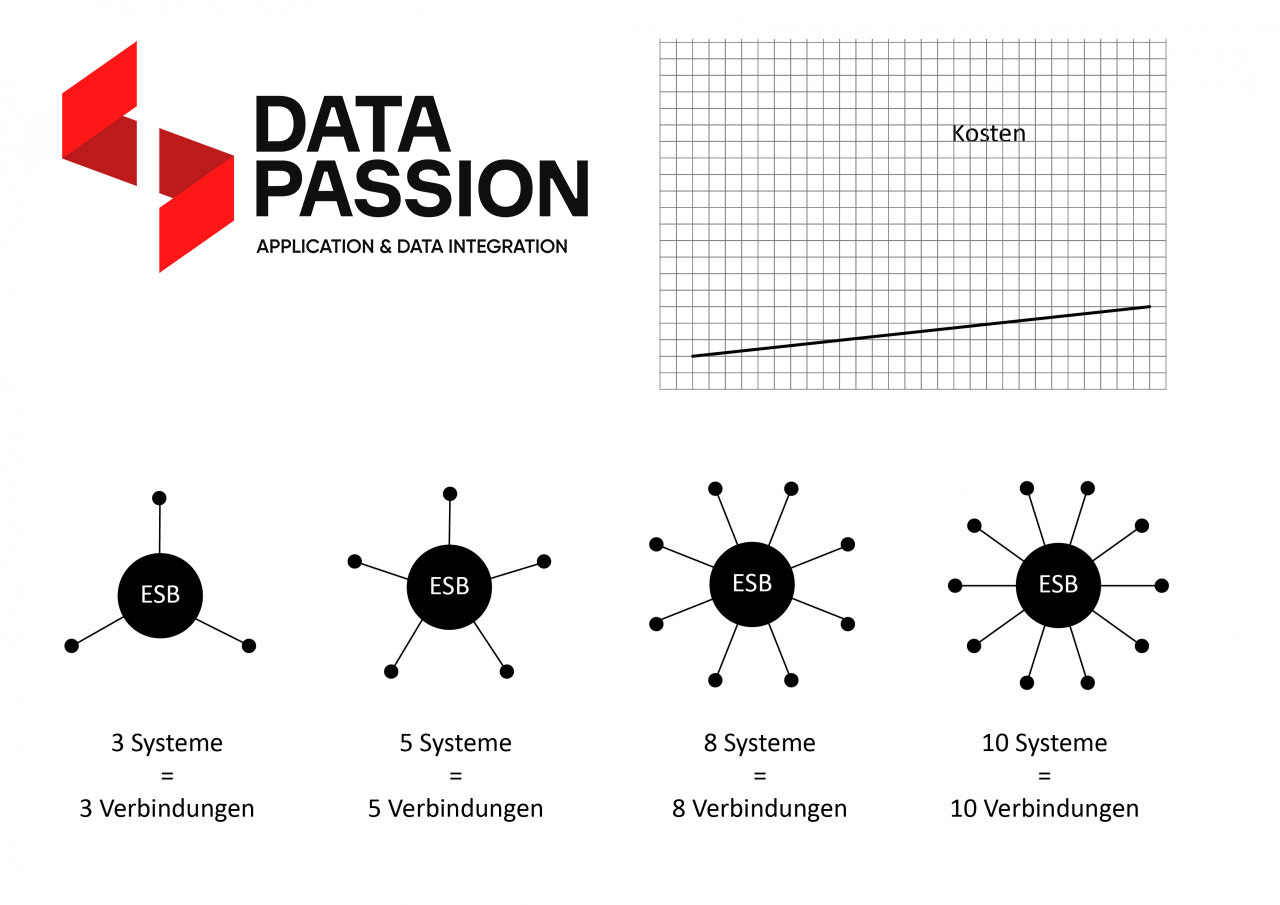
Many integration environments consist of legacy point-to-point connections. The more systems are added, the more fragile and hard to maintain the whole thing becomes. An Enterprise Service Bus (ESB) solves this problem with a central communication layer that connects all systems, transforms data and coordinates processes.
DATA Passion plans, implements and operates ESB-based integration architectures based on modern platforms such as Azure Service Bus, NServiceBus or Lobster. We analyse your existing IT landscape and build the architecture that remains stable, maintainable and scalable in the long term.
before: without ESB
3 Systems
3 Connections
5 Systems
9 Connections
8 Systems
27 Connections
10 Systems
44 Connections
Cost & Complexity
Project workflow
We recommend what fits & not what we prefer.
01
Analyse IT landscape
Before we recommend a platform, we understand your starting point: Which systems are in use? Where do processes break down? What should be automated? Only then do we talk about the right integration solution.
02
choose the right solution
03
Solution integration
Our experts implement, test and document the integration solution. Certified on all supported platforms, with 15+ years of project experience from real-world enterprise environments.
Our experience with complex IT landscapes
Whether ERP, CRM, e-commerce, cloud platform or individual specialist application: We connect standard software, Microsoft technologies and customer-specific systems into stable integration environments. Data flows run automatically, manual interventions are reduced and your IT architecture remains scalable even with new requirements.
FAQ: Frequently asked questions about application integration
Application Integration describes the technical connection of different software applications within a company. The aim is for systems such as ERP, CRM, logistics or e-commerce platforms to automatically communicate with each other, exchange data and processes without manual intervention. Companies with many different systems benefit in particular from a well thought-out integration strategy.
Middleware is software that acts as an intermediary between different applications and systems. It handles communication, data transformation and forwarding between systems that are technically incompatible. Typical examples are Enterprise Service Bus, Message Broker or API Gateways. Middleware is the foundation of stable integration architectures.
An Enterprise Service Bus is a central communication layer that connects all systems in a company. Instead of direct point-to-point connections between individual applications, all communication runs via a central bus. This makes the IT landscape more maintainable, more scalable and much more stable. Data Passion implements ESB architectures based on modern platforms such as Azure Service Bus or nServiceBus.
Azure Integration Services is a collection of Microsoft cloud services for enterprise integration. These include Logic Apps for process automation, Service Bus for reliable messaging, API Management for central interface management, and Azure Functions for event-driven logic. Together they form the basis for modern, cloud-based integration architectures.
Modernization makes sense if interfaces are difficult to maintain or poorly documented, changes take too long or are too risky, only individual people have specialist knowledge, new systems are difficult to integrate or the existing middleware such as BizTalk or classic ESB platforms reached end-of-life. The sooner planning begins, the better the migration can be controlled and implemented without being rushed.
In principle, all common company applications can be integrated. DATA Passion connects, among other things, SAP, Microsoft Dynamics 365, Salesforce, Azure, Lobster, nServiceBus, AWS, Google Cloud, Shopify, Tradebyte, Datev, Sage, Magento and individual in-house developments. The selection of the right integration technology depends on the existing IT landscape, not a manufacturer preference.
An integration project at DATA Passion begins with a structured analysis of the existing IT landscape. We understand the requirements, identify weak points and recommend the right platform and architecture without vendor bias. After the implementation, we document all interfaces and, if desired, support ongoing operations with monitoring, support and further development.
your next step
Unsure which solution suits you?
In a non-binding initial discussion, we will look at your current challenges and potential solutions together.
Honest, direct, free of charge and without obligation.
Send us a short email, call us or fill out the contact form!
We will get back to you within 24 hours.