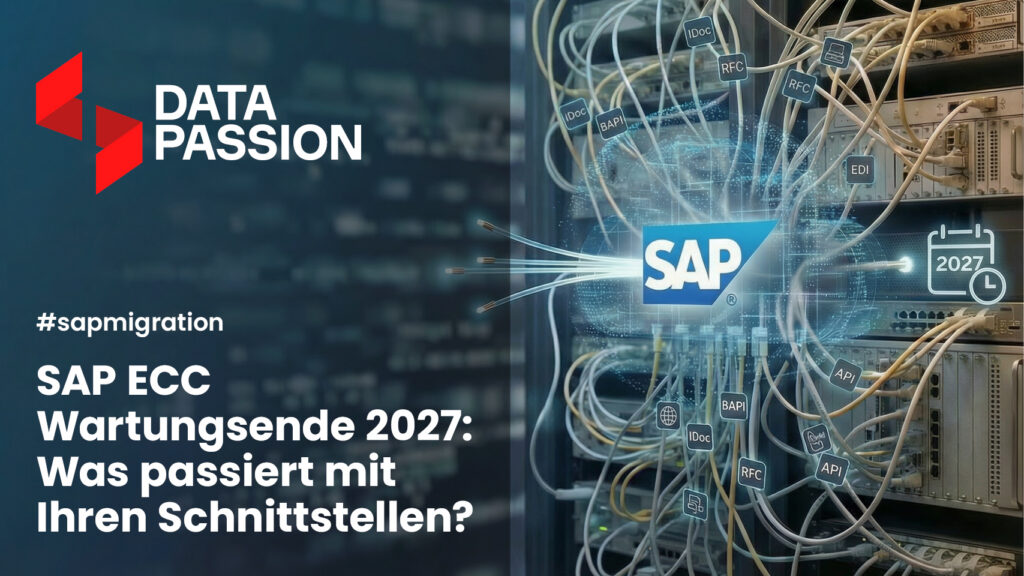

The end of maintenance for SAP ECC in 2027 has long been known, but in most companies the wrong thing is still being discussed. The question is not only: “When do we migrate to S/4HANA?” The question is: “What happens to the 30, 50 or 80 interfaces that are currently hanging on your ECC?”
It is precisely this blind spot that makes SAP migrations more expensive, riskier and longer than planned. And it can be avoided if you address it early enough.
Maintenance meaning
What the SAP ECC end of maintenance specifically means
SAP ECC, officially SAP ERP Central Component, is the ERP system on which a large part of German medium-sized companies and many corporations has been running since the 2000s. For years, SAP has been driving the change to the successor SAP S/4HANA. The end of mainstream support is bindingly communicated:
- end of 2027: Mainstream maintenance for SAP ECC ends. No regular patches, no new security updates, no more standard support.
- by 2030: Optionally bookable Extended Maintenance, chargeable with a surcharge on the current maintenance fee.
- beyond Is there a transition option via Rise with SAP for certain major customers, which enables the further use of individual ECC functionalities. However, under changed contract terms and not as a regular continuation of the previous standard support.
Note: The exact conditions of the Extended Maintenance and other transition options may vary depending on the contract status. Check your situation directly with your SAP account manager.
2026
Today
Analyze, plan, act
end of 2027
Mainstream support ends
No patches, no security updates, no standard support
2030
Extended Maintenance ends
Paid only available on request
from 2030
No support
No more regular path
That sounds like leeway. but it is only conditionally. Experience has shown that S/4HANA programs extend over several quarters to years in complex landscapes.
The integration level is often one of the most complex and risky parts of the program. Anyone who is still in the analysis phase in 2026 is under real pressure.
The underestimated risk
Your integration landscape
Here lies the point that many migration projects recognize too late.
Your SAP ECC system has been your company’s data center for years: orders flow in, delivery notes flow out, financial data goes into reporting, CRM systems synchronize customer master data, suppliers are connected via EDI. All of this happens via interfaces that are calibrated to ECC-specific structures.
What changes with a migration:
- Table structures in S/4HANA differ significantly from ECC. Direct database access and RFC calls must be verified.
- IDoc formats Remain largely compatible, but mapping logics and field occupancy rules may change.
- BAPIs and RFC Connections From middleware configurations, in the course of the migration, you have to check them in a targeted manner and adjust them depending on the target architecture.
- EDI connections Suppliers and trading partners often use middleware systems that are parameterized to specific SAP output formats.
In short: an ECC migration is always an integration review. If you don’t plan to do this, you risk process interruptions after Go-Live.
Which of your interfaces are affected by the migration?
We help you to identify the critical connections at an early stage.
Three migration paths and what integrations they mean
There is no “one” migration. SAP distinguishes between three main scenarios, each with different requirements for the integration level.
Brownfield (System Conversion)
The existing ECC system is technically lifted to S/4HANA. Processes and data are largely retained. For integrations, this means less risk, but not a free ticket. Custom code in interfaces, direct database access and old RFC structures must be actively checked.
Greenfield (reimplementation)
New system, new processes, new architecture. The opportunity: A clean, standardized integration landscape right from the start. The challenge: All interfaces must be rebuilt or completely reconfigured. High effort, but the opportunity to clean up years of integration technical debt.
Hybrid / Selective Data Transition
Certain processes are rethought, others are adopted. A special situation arises here for integrations: the temporary coexistence of ECC and S/4HANA means that the middleware must operate both systems at the same time. This increases the complexity and requires a clear transitional architecture.
Find the right integration platform
Counseling instead of gut feeling
Data Passion’s view of an SAP migration is different from that of an ERP general implementer. Our focus is on the integration level: We analyze which interfaces are affected, which middleware architecture fits the target landscape and which platform is the most sensible choice based on the individual company conditions.
This decision depends on several factors:
- How much is the corporate landscape centered on SAP or Microsoft?
- How many external partners and EDI connections are involved?
- Which middleware is already available and should continue to be used?
- How should the company be organized in the future: internal, external or hybrid?
- What is the strategic target architecture after migration?
From these factors, we will work with you to determine which platform path fits the landscape technically and technically.
Data Passion accompanies all the way: from selection to implementation to ongoing operations.
Data Passion accompanies three paths
From selection to implementation to ongoing operation
None of these options is “the best” per se. Which fits is based on your landscape, your requirements and your target architecture. That is exactly the question we answer together with you.

Microsoft Azure
If Microsoft is the dominant stack or if BizTalk is to be replaced.
fits if;
- D365, Teams, Power Platform
- Biztalk migration is pending
- SAP is a system among several
- Prefabricated components desired
learn more
Relevant if the stack is more focused on Microsoft, i.e. D365, Teams or Power Platform, or when a parallel BizTalk transfer process is pending. Data Passion Smart Connect is available as a separate integration solution based on Azure-based for companies that want to rely on ready-made components, automatic process monitoring and reduced infrastructure costs on this path.
Data Passion Smart Connect Available as a pre-built Azure-based integration solution.

SAP Integration Suite
If SAP remains the strategic core platform and governance is on the SAP side.
fits if;
- SAP as a leading platform
- Integrations closely SAP-coupled
- BTP as a cloud strategy
- Governance on SAP Page
learn more
SAP Integration Suite at BTP:
It makes sense if SAP remains the leading platform, integrations are closely linked to SAP processes and governance and operation are to be deliberately anchored on the SAP side. Data Passion implements, configures and operates the SAP Integration Suite for customers during operation.

Lobster Data Platform
When many external partners, EDI formats and complex supply chains are involved.
fits if;
- Many EDI formats and partners
- No code configuration required
- Fast partner onboarding
- EDIFACT, X12, IDOC in use
learn more
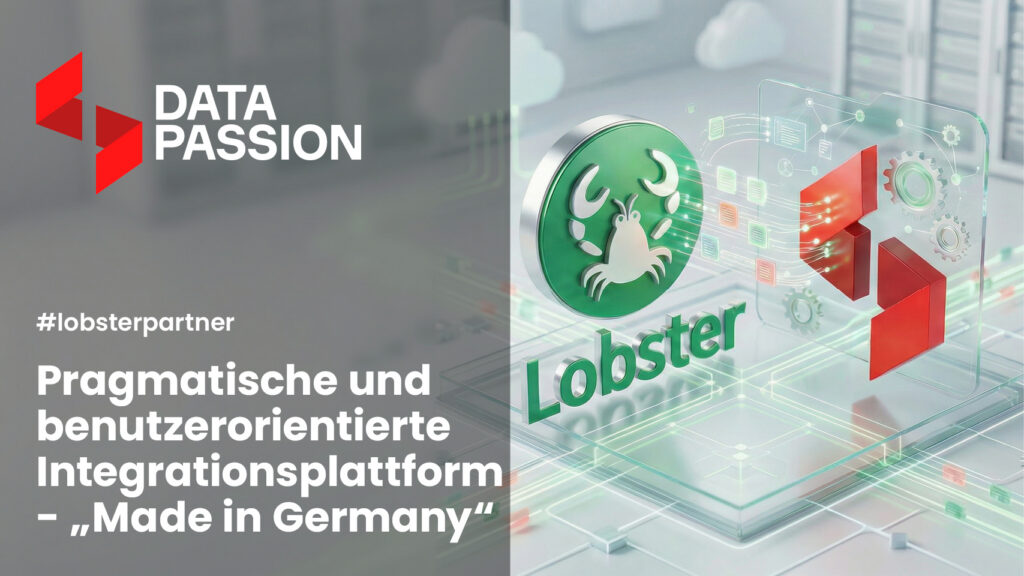
Lobster Data Platform is a specialized option for companies with many external partners, heterogeneous supply chains and high B2B data volume. Lobster bundles data integration, EDI and API management in one tool and works according to a no-code approach: mappings and partner connections can be configured without planning developer resources. The platform supports all common EDI standards such as EDIFACT, X12 and IDOC and brings ready-made connectors for SAP, Salesforce, Microsoft Dynamics and other systems. Data Passion is a certified Lobster partner and accompanies implementation and operation.
start without obligation
Act now before the time pressure decides
Many SAP ECC customers have not yet migrated. Experience has shown that internal and external migration capacities are getting closer the closer in 2027. If you start too late, you lose creative space when choosing the platform, the schedule and the costs.
Waiting is not a neutral option. Those who migrate under pressure accept higher project costs and a real risk of business interruptions in exactly the processes that have to run every day.
The good news: The integration level can be analyzed early, regardless of whether the ERP migration project has already started internally. A structured inventory shows which interfaces are critical, which can be reused and where there is a real need for action.
This is the first step we take with you.